
Loyola’s emphasis on mentorship and translational science has allowed me to develop as a researcher while contributing to work that has real potential to improve patient outcomes.
Emily Krupa
Innovative Research Foundation
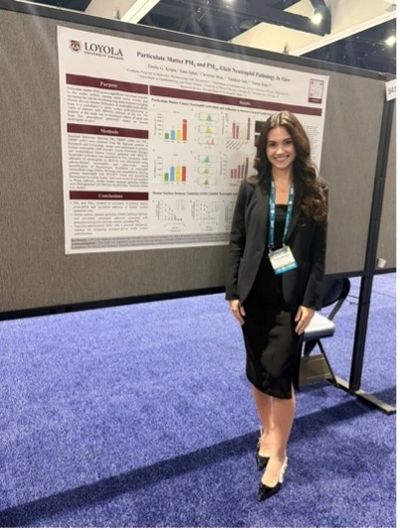
At the Society of Toxicology Annual Meeting in San Diego, Emily presented research demonstrating that airborne particulate matter, commonly found in urban pollution, can trigger harmful neutrophil activation and increase their adhesion to corneal epithelial cells. These findings provide important insight into how environmental exposures contribute to ocular surface disease and long-term ocular toxicity.
Importantly, Emily’s work goes beyond identifying disease mechanisms. Her dissertation research explores the repurposing of existing therapeutics, including immune globulins and heparin, to reduce inflammation and protect the eye. By leveraging drugs with established safety profiles, this work has the potential to accelerate the development of new treatments for patients with limited options.
A defining feature of this research program is its strong collaborative foundation. Emily works closely with clinician-scientists at the University of Illinois Chicago, including NIH-funded collaborations with Dr. Sandeep Jain, ensuring that laboratory discoveries are directly informed by patient care and clinical needs. This partnership strengthens the translational impact of the work and reflects Loyola’s commitment to team-based science.
Loyola’s leadership in the field is further reflected through Dr. Simon Kaja’s role as President of the Midwest Regional Chapter of the Society of Toxicology (MRC SOT). In Fall 2025, Loyola hosted the MRC SOT regional meeting at the Water Tower Campus in Schreiber Hall, bringing together trainees and experts from across the region. Emily was selected to deliver an oral presentation at this meeting - an important recognition of both the quality and impact of her research.
Research Foundation for Sustainability
Emily’s accomplishments have been recognized with multiple competitive honors:
• Ocular Toxicology Specialty Section Early Career Award (SOT)
• Society of Toxicology Midwest Regional Chapter Travel Award
• Arthur J. Schmitt Leadership Fellowship Dissertation Award
She has also been elected Councilor of the Ocular Toxicology Specialty Section of SOT, reflecting her growing leadership and national visibility.
Emily’s work is supported by a strong portfolio of extramural funding that underscores both its scientific merit and clinical relevance. Research in the Ocular Pharmacology and Drug Discovery Laboratory is supported by National Institutes of Health (NIH) funding in collaboration with Dr. Sandeep Jain at the University of Illinois Chicago, as well as a recently awarded Department of Veterans Affairs Office of Research and Development (VA-ORD) grant focused on topical immunotherapy for particulate matter–induced ocular toxicity. This multi-year project, conducted in collaboration with the Edward Hines Jr. VA Hospital, aims to evaluate pooled human immune globulins as a novel therapeutic strategy for ocular surface disease associated with toxic environmental exposures.
Emily’s work highlights the impact of a supportive and mission-driven training environment. Through strong mentorship, interdisciplinary collaboration, and a focus on translational outcomes, Loyola continues to prepare the next generation of scientists to advance innovative therapies that protect vision and improve patient care.
